Smart Home & Building Mechatronics · Intermediate · Low power
ESP8266 Deep-Sleep Mailbox Notifier
A battery node that reports only when a switch closes, and sleeps the rest of the time.
Firmware status: Generated from this project's own pin map and compiled with arduino-cli for esp8266:esp8266:nodemcuv2 before publication; bench validation on your hardware is still required.
Board: ESP8266 (NodeMCU v3 / Wemos D1 mini) · ESP8266EX @ 80 MHz · 3.3 V logic · build for esp8266:esp8266:nodemcuv2.
What you will build
An ESP8266 woken by a reed switch on a mailbox door, reporting the event and sleeping until the next one.
Components
- ESP8266 board with RST wired to GPIO16 for deep sleep
- Reed switch and magnet
- 18650 cell with a protection board
- Jumper wire from GPIO16 to RST
Pin map for this build
| Sketch constant | Pin | What it is |
|---|---|---|
PIN_SENSE | A0 | Sensor — analog output, 3.3 V maximum |
PIN_STATUS_LED | 5 | Status LED — with 220 Ω series resistor |
Tools
- USB programming cable
- Multimeter
- Current-limited bench supply (for anything that switches a load)
- Small screwdriver and wire cutters
Build sequence
- Wire GPIO16 to RST — without it the board cannot wake itself.
- Test the reed switch with a multimeter before trusting it.
- Flash, close the switch, and watch one report appear.
- Leave it overnight and count the reports against how many times the door actually opened.
Test and expected result
One report per event, no reports while the door is closed, and the board survives a week on the cell.
Acceptance checks
one report per event, no false reports, survives unattended
Safety and limits
The 3.7 V cell must go through a regulator to the board, and the board needs its deep-sleep wiring correct or it will never wake.
Hardware scope
Deep sleep on ESP8266, GPIO16 wake, event-driven reporting.
Connection diagram
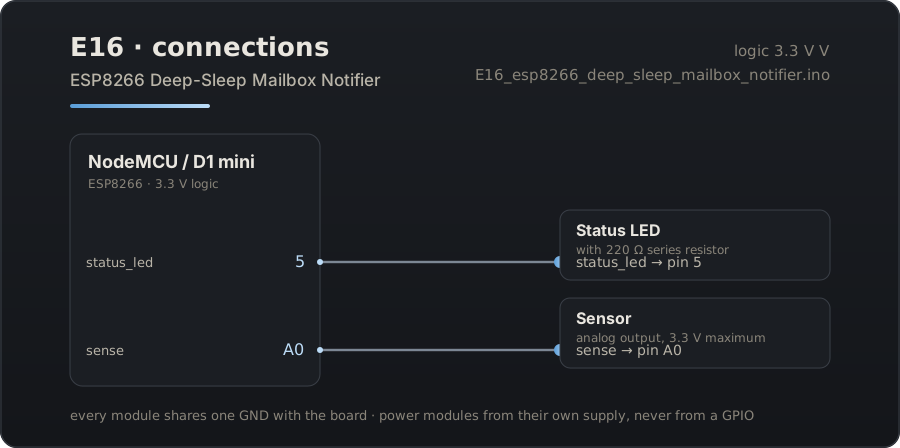
Download the connection diagram (SVG)
Download the Arduino sketch (E16_esp8266_deep_sleep_mailbox_notifier.ino)
Guide source: the sketch on this page was generated from the pin map above and compiled for esp8266:esp8266:nodemcuv2 before publication.
Related projects
- ESP8266 Irrigation Zone Timer — A pump on a schedule, overridden by a page, and stopped by a reservoir float.