ESP32 & ESP8266 Connectivity · Advanced · Peer link
ESP-NOW Two-Board Link
Two boards talking directly, with no router, no broker and no network at all.
Firmware status: Generated from this project's own pin map and compiled with arduino-cli for esp32:esp32:esp32 before publication; bench validation on your hardware is still required.
Board: ESP32 DevKit (ESP32-WROOM-32, 30 or 38 pin) · ESP32 dual core @ 240 MHz · 3.3 V logic · build for esp32:esp32:esp32.
What you will build
A sender and a receiver exchanging structured packets directly, with sequence numbers so a dropped packet is visible.
Components
- Two ESP32 (or two ESP8266) boards
- Analog sensor for the sender
- LED or relay for the receiver
- Two USB cables
Pin map for this build
| Sketch constant | Pin | What it is |
|---|---|---|
PIN_SENSE | 34 | Sensor — analog output, 3.3 V maximum |
PIN_OUT_1 | 4 | Switched output — relay / MOSFET channel, 5 V coil |
Tools
- USB programming cable
- Multimeter
- Current-limited bench supply (for anything that switches a load)
- Small screwdriver and wire cutters
Build sequence
- Flash the sender to one board and note the MAC address in its log.
- Put that address into the receiver's peer table, flash the receiver, and note its MAC.
- Put the receiver's MAC into the sender, reflash the sender, and watch packets arrive.
- Walk the sender out of range and back, and confirm the sequence numbers show the gap.
Test and expected result
Packets arrive with a continuous sequence inside range, gaps are visible, and the link resumes without a reboot when you come back.
Acceptance checks
packets received, sequence continuous in range, resumes after a walk-away
Safety and limits
On the ESP8266 chip, ESP-NOW and Wi-Fi share the radio, so run peer links on a channel that does not collide with your access point.
Hardware scope
Direct peer link, fixed-size packets, callback-driven receive.
Connection diagram
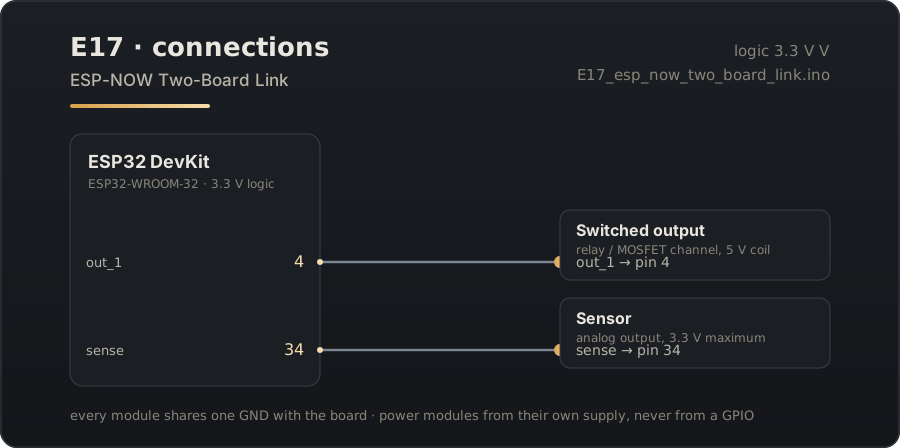
Download the connection diagram (SVG)
Download the Arduino sketch (E17_esp_now_two_board_link.ino)
Guide source: the sketch on this page was generated from the pin map above and compiled for esp32:esp32:esp32 before publication.
Related projects
- ESP32 Captive Portal Wi-Fi Manager — Boot the ESP32 with no credentials and configure its network from a phone, with the portal saved to flash.
- ESP8266 Config Portal — The same idea on the cheapest board that can do it: an ESP8266 that configures itself from a browser.
- ESP8266 Sensor Portal Logger — A battery-minded sensor node you configure in the field, with the reading shown on its own setup page.