ESP32 & ESP8266 Connectivity · Advanced · Peer link
ESP-NOW Remote Output
A receiver that acts on what it hears, without ever joining a network.
Firmware status: Generated from this project's own pin map and compiled with arduino-cli for esp32:esp32:esp32 before publication; bench validation on your hardware is still required.
Board: ESP32 DevKit (ESP32-WROOM-32, 30 or 38 pin) · ESP32 dual core @ 240 MHz · 3.3 V logic · build for esp32:esp32:esp32.
What you will build
A receiver board whose output follows a flag in the incoming packet, with totals logged so a silent link is obvious.
Components
- Two boards (sender and receiver)
- Relay or MOSFET output on the receiver
- Analog sensor on the sender
- Two USB cables
Pin map for this build
| Sketch constant | Pin | What it is |
|---|---|---|
PIN_SENSE | 34 | Sensor — analog output, 3.3 V maximum |
PIN_OUT_1 | 4 | Switched output — relay / MOSFET channel, 5 V coil |
Tools
- USB programming cable
- Multimeter
- Current-limited bench supply (for anything that switches a load)
- Small screwdriver and wire cutters
Build sequence
- Flash the receiver and record its MAC address.
- Set the sender's peer address, flash both, and watch the output follow the incoming flag.
- Hold the sender's sensor above and below the threshold and confirm the output changes on the edge, not continuously.
- Power the receiver from a supply, not USB, and confirm it keeps working.
Test and expected result
The output follows the sender's flag, the receive count climbs, and the receiver runs from its own supply.
Acceptance checks
output follows flag, counts logged, runs unattended
Safety and limits
A remote output is still an output: anything that moves or heats needs a local stop that does not depend on the radio link.
Hardware scope
ESP-NOW receive callback, output actuation, packet totals.
Connection diagram
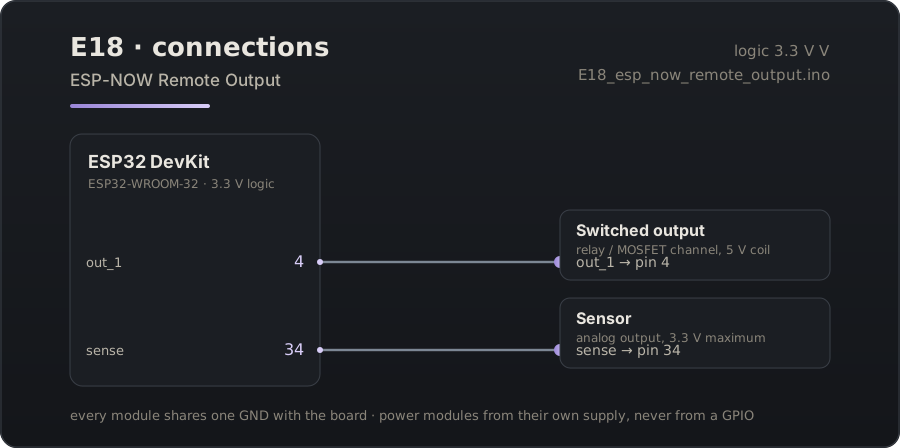
Download the connection diagram (SVG)
Download the Arduino sketch (E18_esp_now_remote_output.ino)
Guide source: the sketch on this page was generated from the pin map above and compiled for esp32:esp32:esp32 before publication.
Related projects
- ESP32 Captive Portal Wi-Fi Manager — Boot the ESP32 with no credentials and configure its network from a phone, with the portal saved to flash.
- ESP8266 Config Portal — The same idea on the cheapest board that can do it: an ESP8266 that configures itself from a browser.
- ESP8266 Sensor Portal Logger — A battery-minded sensor node you configure in the field, with the reading shown on its own setup page.