ESP32 & ESP8266 Connectivity · Advanced · Notifications
ESP32 Telegram Control Bridge
Commands from a phone, replies from the board, and a status command that always answers.
Firmware status: Generated from this project's own pin map and compiled with arduino-cli for esp32:esp32:esp32 before publication; bench validation on your hardware is still required.
Board: ESP32 DevKit (ESP32-WROOM-32, 30 or 38 pin) · ESP32 dual core @ 240 MHz · 3.3 V logic · build for esp32:esp32:esp32.
What you will build
An ESP32 that reads incoming commands, acts on /on, /off and /status, and confirms each action in the thread.
Components
- ESP32 board
- Relay or MOSFET output
- Analog sensor for the status reply
- Telegram bot token and chat id
Pin map for this build
| Sketch constant | Pin | What it is |
|---|---|---|
PIN_SENSE | 34 | Sensor — analog output, 3.3 V maximum |
PIN_OUT_1 | 4 | Switched output — relay / MOSFET channel, 5 V coil |
Tools
- USB programming cable
- Multimeter
- Current-limited bench supply (for anything that switches a load)
- Small screwdriver and wire cutters
Build sequence
- Set the token and chat id and flash.
- Send /on, /off and /status from the phone and confirm each replies.
- Confirm the physical output follows the command and not just the message.
- Send an unknown command and ensure the board does not act on it.
Test and expected result
Three commands work, an unknown command is ignored safely, and the output state and the reported state agree.
Acceptance checks
commands work, unknown commands ignored, output and report agree
Safety and limits
A chat command that moves hardware needs a local override that does not depend on the network or on Telegram being reachable.
Hardware scope
Command polling, JSON parsing, output control with confirmation reply.
Connection diagram
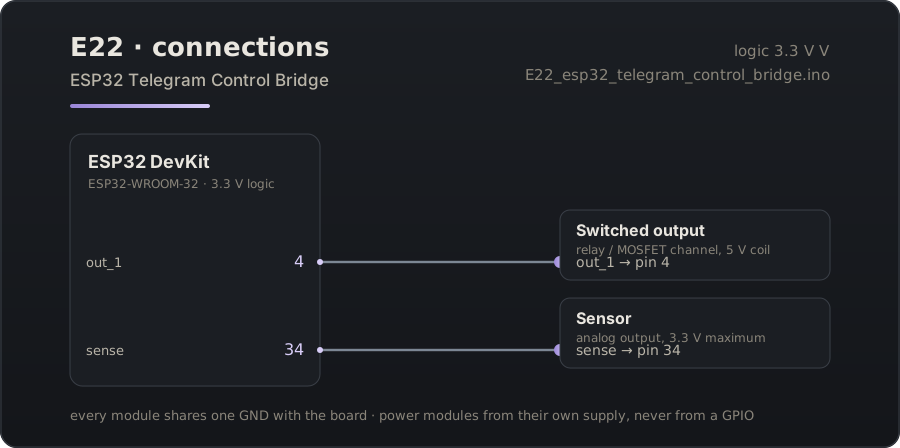
Download the connection diagram (SVG)
Download the Arduino sketch (E22_esp32_telegram_control_bridge.ino)
Guide source: the sketch on this page was generated from the pin map above and compiled for esp32:esp32:esp32 before publication.
Related projects
- ESP32 Captive Portal Wi-Fi Manager — Boot the ESP32 with no credentials and configure its network from a phone, with the portal saved to flash.
- ESP8266 Config Portal — The same idea on the cheapest board that can do it: an ESP8266 that configures itself from a browser.
- ESP8266 Sensor Portal Logger — A battery-minded sensor node you configure in the field, with the reading shown on its own setup page.